The BI tool that maintains itself

A context layer that fixes its own gaps and an Autopilot that cleans dashboards, so your team can stop maintaining BI by hand.

A context layer that fixes its own gaps and an Autopilot that cleans dashboards, so your team can stop maintaining BI by hand.

The fastest data teams don't maintain their BI by hand.

Every BI tool gets messy the moment real people use it. Lightdash is the one that cleans itself up.

Self-improving context layer

Your context layer learns and improves over time.

As your team queries, Lightdash spots where your context layer is thin, out of date, or duplicated, and proposes the fix.

It learns from real questions

Lightdash proposes changes based on the questions people ask and the metrics they reach for.

It proposes the change as a pull request

You review and merge

Autopilot

Your project cleans itself up as you use it.

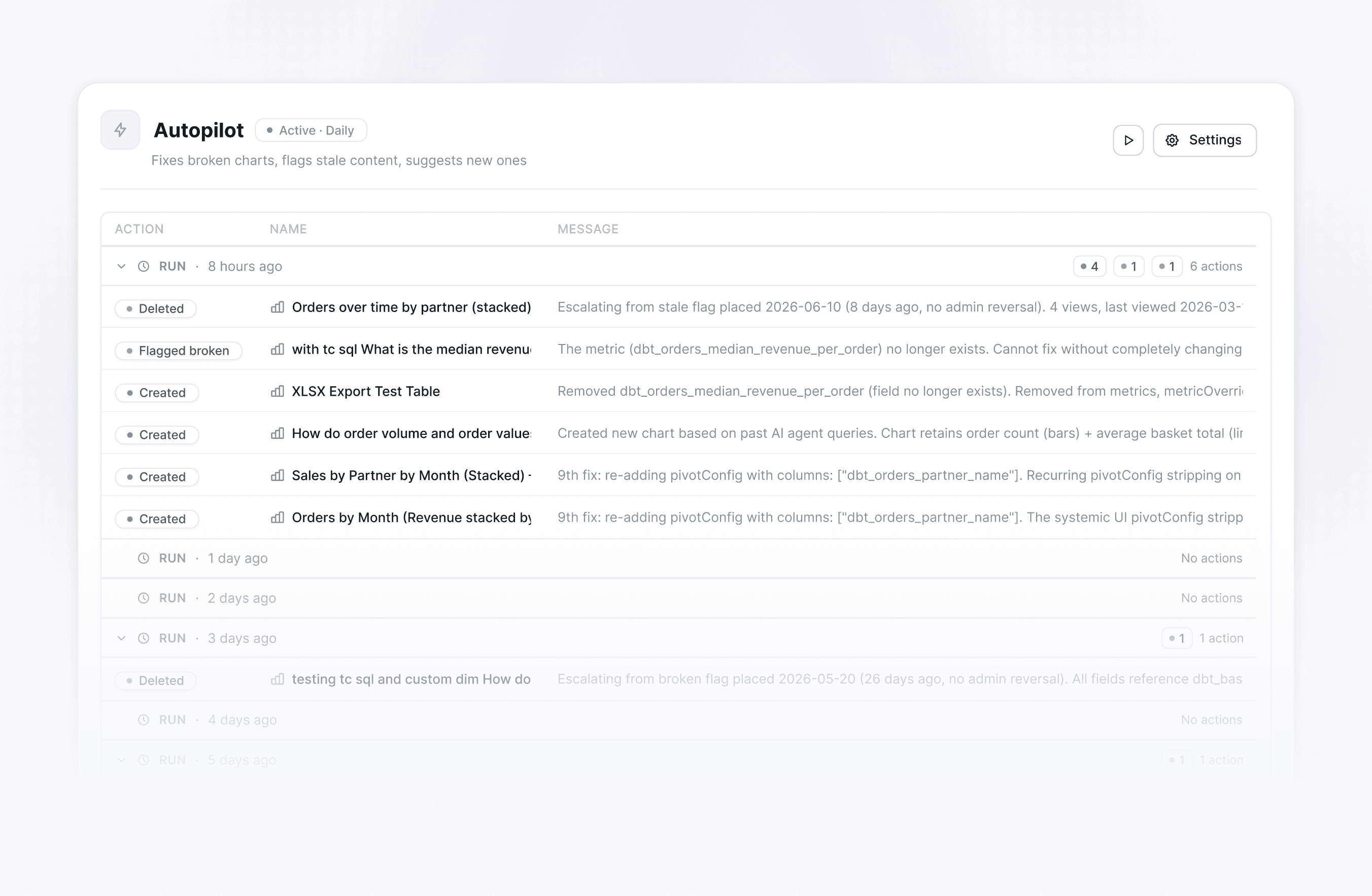
A scheduled agent that runs on a cadence you set. Each run, it reviews recent activity, fixes what it safely can, and flags the rest for review.

It clears the dead weight.

Soft-deletes dashboards with zero views, and flags the ones gathering dust. Run in read-only mode if you want it to flag only.

It fixes what’s broken.

It tells you what to build next.

Every BI tool gets messy the moment real people use it. Lightdash is the one that cleans itself up.

Self-improving context layer

Your context layer learns and improves over time.

As your team queries, Lightdash spots where your context layer is thin, out of date, or duplicated, and proposes the fix.

It learns from real questions

Lightdash proposes changes based on the questions people ask and the metrics they reach for.

It proposes the change as a pull request

You review and merge

Autopilot

Your project cleans itself up as you use it.

A scheduled agent that runs on a cadence you set. Each run, it reviews recent activity, fixes what it safely can, and flags the rest for review.

It clears the dead weight.

Soft-deletes dashboards with zero views, and flags the ones gathering dust. Run in read-only mode if you want it to flag only.

It fixes what’s broken.

It tells you what to build next.

Other tools make maintenance your problem. Lightdash makes it the platform’s.

Lightdash

Legacy BI (Looker, Tableau, Power BI)

Raw LLM on your warehouse

Keeping the semantic layer current

Keeping the semantic layer current

Lightdash

Proposes changes from real usage; you approve

Legacy BI

Manual — your team does it

Raw LLM

No governed metrics at all

Stale & broken content

Stale & broken content

Lightdash

Autopilot cleans and repairs on a schedule

Legacy BI

Manual audits, if they happen

Raw LLM

Not handled

Governed & reversible

Governed & reversible

Lightdash

Every change reviewed, logged, revertible

Legacy BI

Varies by tool

Raw LLM

No governance, no audit trail

Your questions, answered

Your questions, answered

For any other questions, reach out to our team.

How does the self-improving context layer work?

As your team asks questions, Lightdash spots gaps, outdated definitions, and duplicate metrics in your semantic layer. It proposes each fix as a pull request, validated with a compile. You review the change and approve, reject, or revert it.

What does Autopilot do?

Autopilot is a scheduled agent that keeps your Lightdash project clean. On a cadence you set, it soft-deletes charts with zero views older than 30 days, repairs charts that reference missing fields, flags slow queries, and drafts new charts for questions your team keeps asking. Every action is logged with a reason.

Will letting AI edit my context layer or delete dashboards break things?

No. Nothing changes on its own. Context layer edits arrive as pull requests you review before merging. Autopilot only soft-deletes (everything is restorable), never touches content under 30 days old, and reverses its own mistakes on the next run. You can also run it in read-only mode so it only flags.

How is this different from pointing an LLM at my warehouse?

A raw LLM on your warehouse has no governed metrics, no business context, and no permissions, so it guesses. Lightdash works on your governed semantic layer: every metric is defined in code, every change is reviewed, and every action is logged. You get the automation without losing your source of truth.

Do I need dbt to use self-improving analytics?

dbt is the most common setup. Lightdash builds its semantic layer inside your dbt project, or you can define it in Lightdash YAML against your warehouse without dbt.

I have an infrequently asked question.

Great! We're always around to help. You can chat to us through the live chat on this webpage, or talk to us in our Slack community.

Stop maintaining BI by hand.

Write your context layer in code and let Lightdash keep it up to date.

Stop maintaining BI by hand.

Write your context layer in code and let Lightdash keep it up to date.

Join our newsletter to be en-lightened

© 2026 Telescope Technology Limited. All rights reserved.

Join our newsletter to be en-lightened

© 2026 Telescope Technology Limited. All rights reserved.

Join our newsletter to be en-lightened

© 2026 Telescope Technology Limited. All rights reserved.